Q1.
A media education portal needs a vibrant “YouTube Insights” page that presents key platform statistics in a clear table format, so build a webpage that displays YouTube metrics in a tabular form with a header, body rows and a footer citation.
A screenshot of the example webpage is shared below: 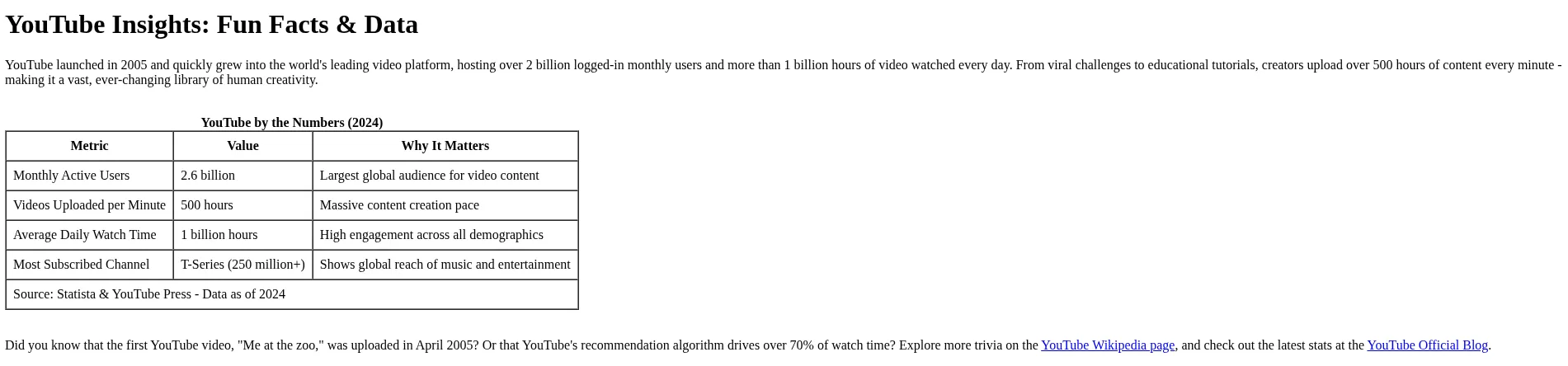
Q2.
Consider the html code snippet given below:
<!DOCTYPE html>
<html lang="en">
  <head>
    <meta charset="UTF-8" />
    <meta name="viewport" content="width=device-width, initial-scale=1.0" />
    <title>HTML Elements</title>
  </head>
  <body>
    <h1>History of CSS</h1>
    <p>
      CSS was created HÃ¥kon Wium Lie to allow web designers to change the
      layout, colors, and fonts of their websites. Originally, websites were
      meant to be used by researchers only, so the decoration did not matter.
      However, when websites became widespread, the need to make them look nice
      grew.
    </p>

    <a href="https://en.wikipedia.org/wiki/H%C3%A5kon_Wium_Lie
      >Wikipedia page of Håkon Wium Lie</a
    >

    <br />

    <img
      src="https://upload.wikimedia.org/wikipedia/commons/9/96/H%C3%A5kon-Wium-Lie-2009-03.jpg"
      alt="A photo of Håkon Wium Lie"
      width="300"
      height="auto"
    />
    <br /><br />

    <h2>Timeline</h2>

    <li>1994 - HÃ¥kon Wium Lie proposed the idea of CSS.</li>
    <li>1996 - The first version of CSS was invented.</li>
    <li>
      1998 - CSS 2 was released and work on CSS 3 began. CSS 3 was very
      different from the other versions, instead of being a single monolithic
      specification, it was published as a set of separate documents known as
      modules. Each module dealt with a relatively small subset of the overall
      specification, and either added new features or refined and extended
      existing features. All additions and enhancements to the specification
      were written in order to be backward-compatible with older versions of
      CSS.
    </li>
    <li>2011 - CSS 2.1 was released, which fixed the errors found in CSS 2</li>

    <br />

    <br />

    <table border="1" cellspacing="0" cellpadding="8">
      <h2>CSS Versions & Milestones</h2>
      <tr>
        <h4>Year</h4>
        <h4>Version</h4>
        <h4>Key Highlights</h4>
      </tr>
      <tr>
        <td>1994</td>
        <td>CSS 1</td>
        <td>
          Proposal by Håkon Wium Lie introducing basic selectors, color, fonts,
          and box model
        </td>
      </tr>
      <tr>
        <td>1998</td>
        <td>CSS 2</td>
        <td>Positioning, z-index, media types, and table layout features</td>
      </tr>
      <tr>
        <td>2011</td>
        <td>CSS 2.1</td>
        <td>
          Bug fixes and clarifications to CSS 2, improving browser
          interoperability
        </td>
      </tr>
      <tr>
        <td>2012-</td>
        <td>CSS 3</td>
        <td>
          Modular specs—selectors, flexbox, animations, transitions, media
          queries, and more
        </td>
      </tr>
      <tr>
        <td colspan="3">Source: W3C CSS History & Module Specifications</td>
      </tr>
    </table>
  </body>
</html>
Although this HTML displays the content, it doesn’t seem to follow proper HTML semantics and structure. Identify what’s invalid or missing and fix it.